

Getting a new gas grill, water heater, or generator installed in Plymouth, MA sounds straightforward until you realize how many legal requirements stand between you and a working appliance. Massachusetts has some of the strictest gas installation rules in the country, and skipping steps can mean fines, voided insurance, or worse. DIY gas work is illegal in MA and can result in explosions, denied claims, and serious liability. This guide walks you through every stage of a safe, code-compliant gas installation so you can move forward with confidence and avoid costly mistakes.
Key Takeaways
| Point | Details |
|---|---|
| Licensing is mandatory | Only licensed gas fitters may legally install or service gas appliances in Massachusetts. |
| Approved materials only | Black steel or CSST must be used for gas lines; copper is not allowed. |
| Permits and inspections required | Permits must be secured before work begins, and passing inspection is necessary to operate safely and legally. |
| Step-by-step matters | Proper prep, installation, and testing prevent failure, fines, and hazardous conditions. |
| Safety over shortcuts | Cutting corners on gas work can lead to serious injury, legal trouble, and insurance denial. |
What You Need Before Starting a Gas Installation
Now that you understand the risks, let’s get clear on what the law requires before you even schedule a service. In Massachusetts, gas installation is tightly regulated, and for good reason. A small mistake with gas piping can have consequences that no homeowner wants to face.
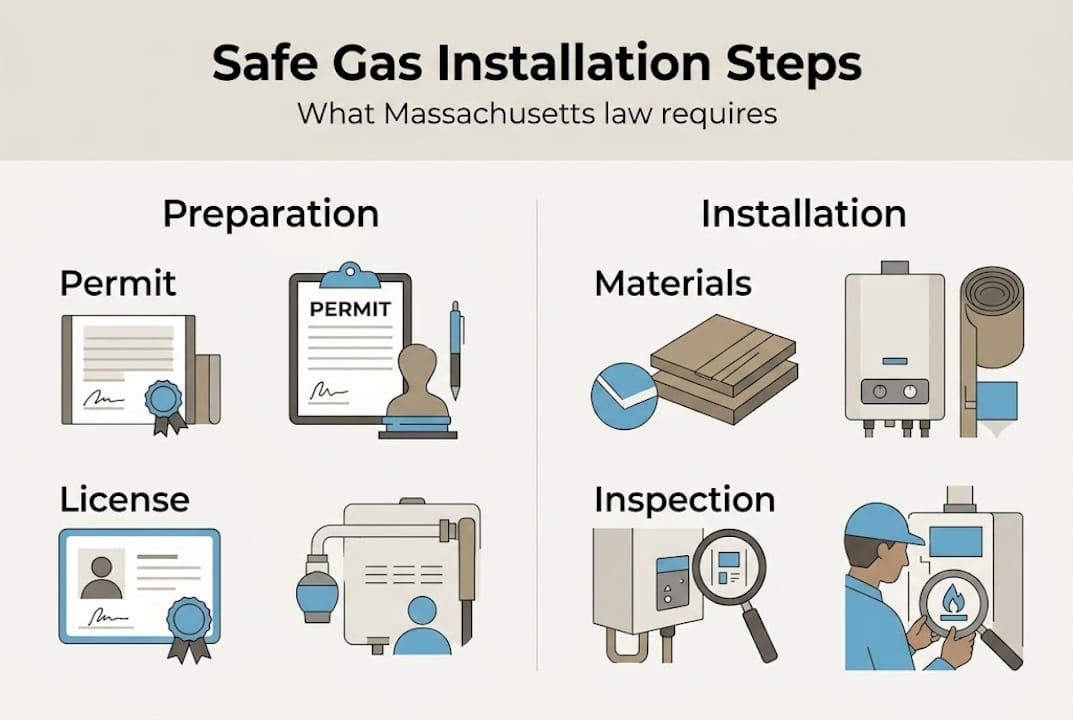
First, the legal basics. All gas installation work in Massachusetts must be performed by a licensed gas fitter and requires both a permit and a formal inspection before the appliance can be used. This applies to every common appliance: outdoor grills with permanent connections, water heaters, whole-home generators, boilers, and more. There are no exceptions for “minor” hookups.
Here’s what you should gather and confirm before any work begins:
- Proof of licensing: Your installer must hold a valid Massachusetts gas fitter’s license. Ask for it in writing before signing anything.
- Permit confirmation: The licensed professional typically pulls the permit from the Plymouth Building Department on your behalf, but always confirm this step.
- Inspection schedule: A municipal inspector must approve the installation after it’s complete. Your installer should coordinate this for you.
- Appliance specifications: Have the model number, BTU rating, and manufacturer’s installation guide ready for your gas fitter.
- Utility notice: Some jobs, especially generators, may require notifying your gas utility before work begins.
Why does this matter so much? Licensed professionals reduce leak risks by 70 to 90 percent compared to unlicensed work. That’s not a small margin. That’s the difference between a safe home and a dangerous one.
| Requirement | Who handles it | Timeline |
|---|---|---|
| Gas fitter license | Installer | Before scheduling |
| Installation permit | Installer (for you) | Before work begins |
| Municipal inspection | Inspector + Installer | After install is complete |
| Utility notification | Homeowner or installer | Varies by project |
The Plymouth Building Department issues gas permits locally. Permit fees vary by project scope, but your licensed gas line installation professional should walk you through the costs up front.
Pro Tip: Never let a contractor start gas work without a permit in hand. If something goes wrong during an unpermitted job, your homeowner’s insurance will almost certainly deny the claim.
Choosing Safe Materials and the Right Installer
With your legal requirements in hand, it’s time to focus on picking safe materials and the right professional. Not all gas piping is created equal, and Massachusetts code is very specific about what you can and cannot use.
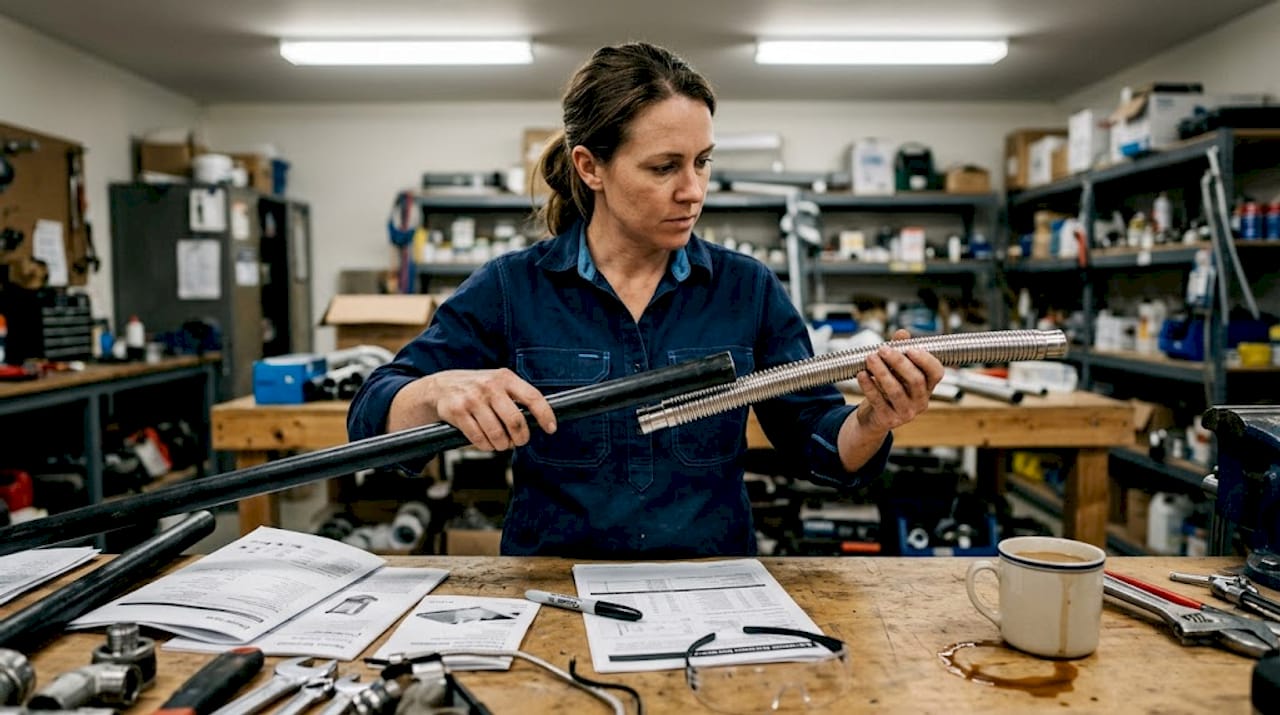
For natural gas lines, two materials are approved: black steel pipe and CSST (corrugated stainless steel tubing, a flexible piping option). Copper is prohibited for natural gas in Massachusetts. Approved gas line materials include black steel and CSST, and all systems must undergo pressure testing at 60 psi for 10 minutes to verify no leaks before use.
| Material | Pros | Cons |
|---|---|---|
| Black steel pipe | Durable, widely available, low-cost | Rigid, harder to route through walls |
| CSST | Flexible, faster to install, space-saving | Higher material cost requires bonding |
| Copper | N/A | Prohibited for natural gas in MA |
Choosing the right installer is just as important as choosing the right pipe. Here’s how to verify you’re working with a qualified pro:
- Ask for their Massachusetts gas fitter license number and look it up at the state’s licensing board.
- Confirm they carry liability insurance and workers’ compensation coverage.
- Ask whether they pull permits as part of their standard process. Any hesitation is a red flag.
- Request references from local Plymouth-area jobs, especially for the appliance type you need.
- Get a written quote that itemizes materials, labor, permit fees, and inspection coordination.
“A licensed gas fitter doesn’t just connect pipes. They size the line correctly for your appliance’s BTU load, verify connector length limits, and ensure every fitting is code-compliant before the inspector ever shows up.”
Connector length limits are a real concern. Flexible connectors from the supply line to your appliance are limited in length by code, and using an oversized connector is a common violation that inspectors catch. Check out these essential gas installation tips to understand what your installer should be doing at every stage.
Pro Tip: If a contractor offers to skip the pressure test to save time, walk away. That 10-minute test is what proves your system has zero leaks. There is no safe shortcut.
For a full list of available local gas installation services in Plymouth, you can review options before calling.
Step-By-Step Process for Appliance Installation (Grills, Water Heaters, Generators)
Once you’ve chosen safe components and a certified installer, here’s exactly what the installation journey looks like for each appliance.
Before any installation starts:
- Locate and test the main gas shutoff valve.
- Clear a safe access path for the inspector.
- Install carbon monoxide (CO) detectors on the same floor as any new gas appliance.
- Confirm the gas meter has enough capacity for the added load.
Gas grill installation:
- Your installer runs a dedicated gas line from your home’s supply to the outdoor connection point.
- A shutoff valve is installed near the grill location for safety.
- The line is pressure tested at 60 psi before the grill is connected.
- A flexible connector joins the gas supply to the grill per code-approved length limits.
- A leak check is performed with a gas detector or soap solution before use.
Check out our gas grill installation services for Plymouth-specific pricing and availability.
Gas water heater installation:
Water heaters in Massachusetts require seismic strapping, pressure-temperature (PT) relief valves, and specific venting for tankless models. The install process includes disconnecting the old unit, repositioning if needed, connecting gas and water lines, and testing the PT relief valve and venting.
Tankless water heaters add an extra layer of complexity because they require direct venting through an exterior wall. Your gas water heater installation professional handles all of this as part of the permitted job.
Gas generator installation:
This is the most complex of the three. Generator installations in Massachusetts require gas piping sized specifically for the generator’s load, permits, an automatic transfer switch (ATS), and full NFPA 70 compliance. The gas utility may also need to upgrade your meter if the generator’s demand exceeds current capacity.
Your installer coordinates all generator gas piping permits and works alongside the electrical contractor handling the ATS installation.
Statistic to know: Improperly sized gas lines are one of the top reasons generator installations fail inspection the first time. Sizing matters more than most homeowners realize.
Final Verification: Testing, Inspection, and Edge Cases
After your appliances are installed, ensuring everything meets legal and safety standards is crucial. This is where many homeowners get surprised because the job isn’t done until an inspector signs off.
Here’s what the final verification phase includes:
- Pressure test: The entire gas system is tested at 60 psi for a minimum of 10 minutes. Any drop in pressure indicates a leak that must be fixed before proceeding.
- Leak check: Every connection is checked with an approved gas detector or soap solution.
- CO detector verification: Inspectors confirm detectors are installed on the correct floor, within code-required distance of appliances.
- Appliance operation check: The gas fitter cycles each appliance through a startup and confirms stable operation.
Inspectors also look for common edge cases that can cause a failed inspection:
According to 248 CMR Massachusetts Code, edge cases include venting pressure regulators outdoors, CO detectors on the same floor as new appliances, and prohibited manifold types. Each of these can trigger a failed inspection if overlooked.
If your new appliance requires a gas pressure regulator (a device that controls line pressure), that regulator must vent to the outdoors, not inside a wall or enclosed space. Improper regulator venting is a top-cited violation in Plymouth inspections.
For future planning, keep a folder with all permits, inspection certificates, and appliance manuals. Utility rebates for energy-efficient water heaters and generators often require proof of licensed installation and inspection. Review your gas line safety standards reference periodically if you add more appliances over time.
If you ever suspect a code violation or smell gas, call your gas utility immediately and then contact a licensed professional. Do not attempt to locate or fix the issue yourself. Learn more about safe gas fitting practices to understand how licensed fitters approach these situations.
Pro Tip: Keep your inspection certificate in a safe place. When you sell your home, buyers and real estate attorneys often request proof that gas appliances were installed with permits and passed inspection.
A Professional’s Take: Safety Saves Money and Lives
Let’s step back and address why all this process and professionalism matters in the bigger picture. We’ve seen what happens when homeowners try to save a few hundred dollars by skipping the permit or hiring an unlicensed handyman. It rarely ends well.
The uncomfortable truth about gas work is this: quality is invisible until something goes wrong. A poorly fitted connection can sit quietly for months before a small leak builds up to a real problem. By then, the cost is never just financial.
Insurance companies know this too. When a gas-related claim is filed and the investigation reveals unpermitted work, the claim gets denied. Every time. That means the homeowner pays out of pocket for damage that could have been avoided entirely by doing things right the first time.
We also want to be honest about cost. A properly permitted, inspected gas installation typically costs more upfront than a handyman quote. But that upfront cost is real protection. Understanding what gas fitting involves helps you see why licensed work costs what it does and why it’s worth every dollar. Think of it less as a service fee and more as an investment in your family’s safety.
Get Expert Gas Installation Help in Plymouth
If you want true peace of mind for your next project, here’s the simplest way to ensure everything is done right.

At 8th Bend Plumbing, we handle gas grill hookups, water heater replacements, generator piping, boiler connections, and more, all with proper permits and licensed professionals who know Plymouth’s local code requirements. Whether you need a new gas installation or are considering a tankless water heater installation, our team makes the process smooth and stress-free. We also offer plumbing repair services for any related needs that come up during your project. Contact us today to get a clear quote and a scheduled inspection, so you can enjoy your new appliance with complete confidence.
Frequently Asked Questions
Is it illegal to do your own gas installation in Massachusetts?
Yes, DIY gas installation in MA is illegal and can result in fines, failed insurance claims, and serious safety hazards including explosions.
What permits are required for installing a gas appliance in Plymouth, MA?
You need a permit from the Plymouth Building Department, and licensed gas fitters must perform all work and coordinate the required inspection.
Which piping materials are allowed for natural gas lines in Massachusetts?
Only black steel and CSST are approved; copper is prohibited for natural gas lines under Massachusetts code.
What special requirements exist for gas water heaters and generators?
Water heaters require seismic strapping and proper venting, while generators need load-sized gas piping, permits, and potentially a utility meter upgrade.
How do I know a gas installation passed the final inspection?
Inspectors verify pressure tests, code-compliant install, and CO detector placement, then issue a signed certificate confirming the work passed.


