

Water from the tap does not always inspire confidence when you know that PFAS chemicals are detected in about 45% of American drinking water samples, according to recent studies. Plymouth homeowners face a unique mix of water issues that affect both comfort and long-term health, from stubborn hard water minerals to persistent chlorine taste and hidden chemical threats. Discover how understanding these concerns helps you protect your family’s well-being and keep your home’s water quality at its best.
Key Takeaways
| Point | Details |
|---|---|
| Hard Water Effects | Hard water can cause scale buildup and damage household appliances while reducing cleaning efficiency. |
| PFAS Contamination Risks | PFAS chemicals pose significant health risks, including potential links to cancer, and are found in a substantial percentage of water samples. |
| Importance of Filtration | Investing in advanced filtration technologies is crucial for protecting health and improving water quality in Plymouth homes. |
| Regulatory Standards | Compliance with evolving regulations is key to ensuring safe drinking water and effective management of contaminants. |
Understanding Hard Water, Chlorine, and PFAS
Homeowners in Plymouth face complex water quality challenges involving hard water, chlorine, and PFAS contaminants. These substances can significantly impact drinking water safety, household appliances, and overall health. PFAS research by the EPA reveals these synthetic chemicals are persistent environmental pollutants with widespread implications.
Hard water contains elevated mineral concentrations, primarily calcium and magnesium, which can cause multiple household issues:
- Scale buildup in pipes and appliances
- Reduced soap and detergent effectiveness
- Potential increased wear on plumbing fixtures
- Higher energy consumption for water heating
Chlorine, commonly used for water disinfection, serves a critical purpose in eliminating harmful bacteria. However, it can produce unintended consequences like altered water taste and potential interaction with organic compounds.
PFAS chemicals, manufactured since the 1930s, represent a more insidious water contamination challenge. These synthetic compounds have been extensively used in products ranging from nonstick cookware to firefighting foams. Consumer Product Safety Commission research indicates they persistently accumulate in environmental systems and human bodies.
Pro tip: Consider professional water testing to identify specific contaminants in your Plymouth home’s water supply and develop targeted filtration strategies.
Local Water Sources and Common Problems
Plymouth’s water sources face complex contamination challenges that directly impact residential water quality. PFAS contamination research indicates significant environmental risks across various water systems, revealing the intricate nature of local water management.
Local water sources typically include:
- Municipal water treatment facilities
- Groundwater wells
- Surface water from rivers and reservoirs
- Private residential wells
The diversity of water sources means each presents unique contamination risks. Scientific data suggests that approximately 45% of drinking water samples contain detectable levels of PFAS chemicals, with concentrations varying dramatically based on local industrial and agricultural activities.
Geological factors play a critical role in water quality, influencing mineral content, potential contaminant pathways, and overall water characteristics. Plymouth’s specific geological composition determines the likelihood of hard water minerals, chlorine interactions, and potential PFAS accumulation. Comprehensive water quality studies demonstrate how regional environmental conditions dramatically impact water system compositions.
Understanding these local water challenges requires comprehensive testing and targeted filtration strategies that address the specific contaminants present in individual water sources.
Pro tip: Schedule a professional water quality assessment to precisely identify the unique contaminants in your specific Plymouth water source and develop a customized filtration approach.
Health and Home Impacts of Water Contaminants
Water contaminants pose significant risks to both household infrastructure and human health, with each type of pollutant presenting unique challenges. PFAS exposure research reveals critical connections between water quality and potential long-term health consequences, highlighting the importance of comprehensive water management.
Potential health impacts of water contaminants include:
- Increased cancer risk
- Developmental disorders
- Immune system suppression
- Hormonal disruptions
- Potential neurological complications
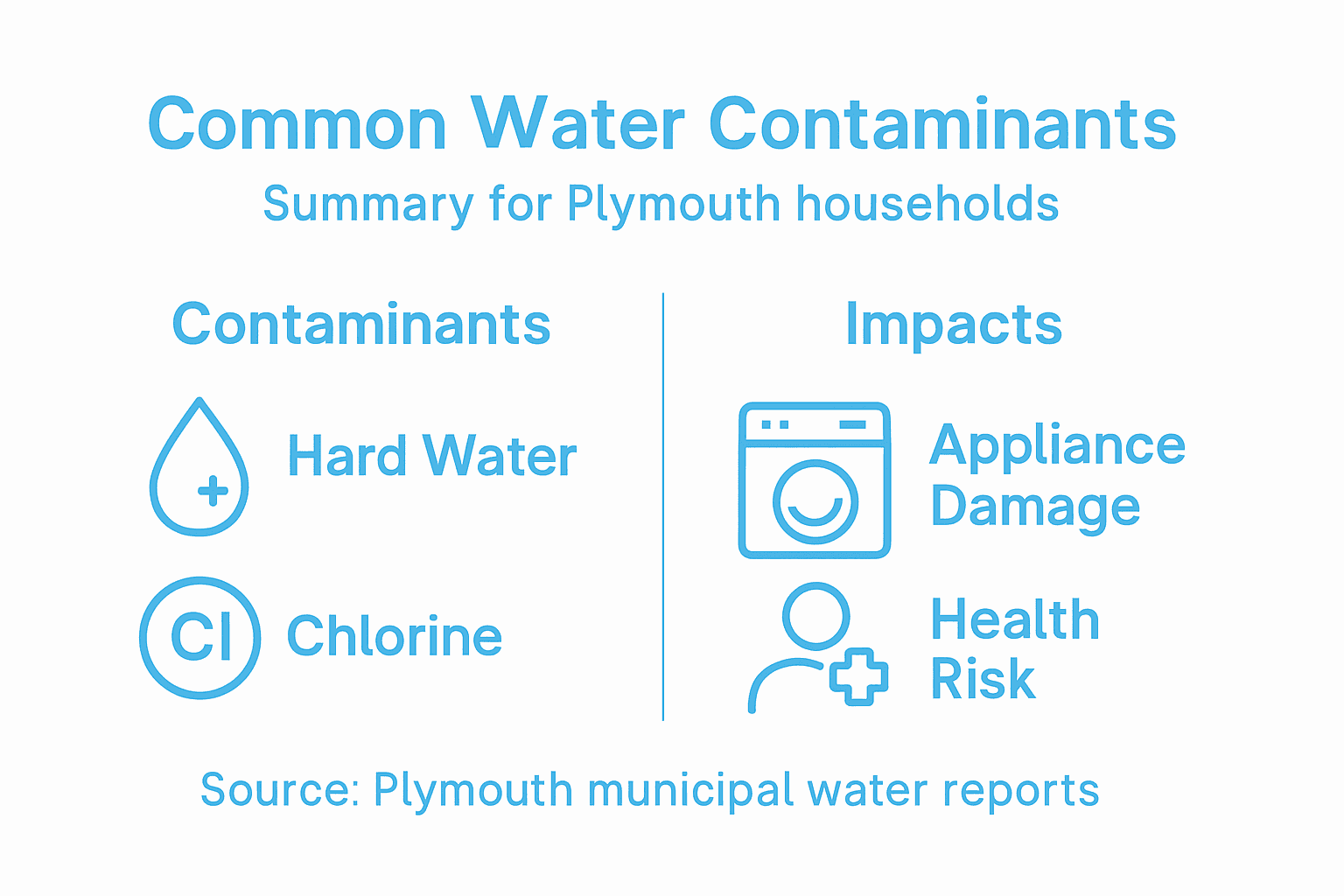
Chlorine, while essential for water disinfection, can produce harmful byproducts that potentially compromise health over extended periods. Hard water minerals, though less immediately dangerous, create significant household challenges by causing appliance damage and reducing cleaning efficiency.

PFAS chemicals represent the most concerning contaminant, with scientific evidence suggesting potential links to serious health conditions. Academic research synthesizing water contamination studies demonstrates that drinking water serves as a primary exposure pathway for these persistent environmental compounds, underscoring the critical need for advanced filtration technologies.
Pro tip: Invest in a comprehensive water testing kit to identify specific contaminants in your home’s water supply and develop a targeted filtration strategy.
Here’s a quick comparison of how different water contaminants affect Plymouth homes and health:
| Contaminant | Household Impact | Health Risk | Prevalence in Plymouth |
|---|---|---|---|
| Hard Water | Appliance damage, scale | Minimal direct health risk | Common in local groundwater |
| Chlorine | Taste change, pipe wear | Byproducts may be harmful | Often present in treatment |
| PFAS | Invisible chemical buildup | Increased cancer risk | Detected in 45% of samples |
Regulations, Safety Standards, and Legal Limits
Water quality regulations represent a complex landscape of federal and state guidelines designed to protect public health. EPA’s key actions addressing PFAS demonstrate an evolving regulatory framework that continuously adapts to emerging scientific understanding of water contaminants.
Key regulatory focus areas include:
- Establishing maximum contaminant levels
- Monitoring water treatment processes
- Implementing testing and reporting requirements
- Developing remediation strategies
- Creating public disclosure mechanisms
Drinking water standards require water utilities to meet stringent testing protocols for various contaminants, including PFAS, chlorine byproducts, and hard water mineral concentrations. These regulations mandate comprehensive monitoring and reporting to ensure public safety.
Water professional organizations emphasize collaborative approaches between federal agencies, state regulators, and local water management entities to address emerging water quality challenges. This multi-tiered regulatory strategy aims to protect communities by establishing clear guidelines for water treatment, testing, and contamination management.
Pro tip: Request an annual water quality report from your local water utility to understand specific contaminant levels and regulatory compliance in your area.
Why Plymouth Residents Invest in Filtration
Plymouth homeowners are increasingly prioritizing water quality through advanced filtration technologies that address multiple environmental challenges. Community health studies reveal substantial motivations for investing in comprehensive water treatment systems, ranging from health protection to household maintenance.
Key reasons for water filtration investment include:
- Reducing potential exposure to PFAS chemicals
- Protecting household appliances from hard water damage
- Improving overall water taste and odor
- Eliminating chlorine and mineral contaminants
- Enhancing long-term family health outcomes
Regulatory changes have further accelerated residential filtration adoption. EPA guidelines addressing water contamination underscore the growing recognition of complex water quality challenges that extend beyond traditional treatment approaches. These evolving standards demonstrate increasing governmental commitment to protecting public health through more rigorous water management protocols.
Modern filtration technologies offer Plymouth residents a proactive approach to managing water quality, transforming municipal water supplies into safer, more reliable household resources that protect both personal health and residential infrastructure.
Pro tip: Schedule a professional water quality assessment to identify your specific filtration needs and develop a targeted treatment strategy.
Comparing Filtration Technologies and Effectiveness
Comprehensive water treatment technologies reveal multiple strategies for addressing Plymouth’s complex water contamination challenges. Different filtration methods target specific contaminants with varying levels of effectiveness, creating tailored solutions for household water quality.
Primary filtration technologies include:
- Activated carbon filters
- Reverse osmosis systems
- Ion exchange resins
- Ceramic membrane filters
- Ultraviolet purification systems
Activated carbon filtration remains particularly effective for removing chlorine, organic compounds, and certain chemical contaminants. These filters work by trapping impurities through a process of adsorption, creating a physical barrier that prevents harmful substances from passing through.
EPA water research indicates that point-of-use filters combining multiple technologies offer the most comprehensive protection against complex water quality issues. Reverse osmosis systems, for instance, can remove up to 99% of PFAS chemicals, hard water minerals, and other dissolved solids, providing a multi-layered approach to water treatment.
Pro tip: Consult a professional water treatment specialist to conduct a comprehensive water analysis and recommend a customized filtration system tailored to your specific water quality challenges.
This overview highlights the strengths and limitations of common residential filtration technologies:
| Technology | Main Strength | Limitations | Contaminants Targeted |
|---|---|---|---|
| Activated Carbon | Removes chlorine, odors | Limited PFAS removal | Chlorine, organics, some PFAS |
| Reverse Osmosis | Broad contaminant reduction | Slow flow, waste water | PFAS, minerals, solids |
| Ion Exchange | Effective for mineral removal | Not for organics or PFAS | Calcium, magnesium |
| UV Purification | Kills microbes | Does not remove chemicals | Bacteria, viruses |
Protect Your Plymouth Home from Hard Water, Chlorine, and PFAS with Expert Filtration Solutions
Dealing with hard water scale buildup, unpleasant chlorine taste, or hidden PFAS chemicals in your water can feel overwhelming and risky for your family’s health and your home’s plumbing. These common water challenges in Plymouth impact everything from appliance longevity to your peace of mind. At 8th Bend Plumbing Heating and Cooling, we specialize in reliable home water filtration system installations designed to target these exact contaminants effectively.

Take control of your water quality today with trusted professionals who understand the unique Plymouth water concerns. By choosing our comprehensive filter solutions, you protect your household from mineral damage, chemical impurities, and unseen PFAS threats. Don’t wait until water problems escalate into costly repairs. Visit our website or contact us to schedule your water quality assessment and explore tailored filtration and plumbing repair services. Safeguard your health and home now with 8th Bend Plumbing, Heating, and Cooling.
Frequently Asked Questions
What are the effects of hard water on household appliances?
Hard water can cause scale buildup in pipes and appliances, reduce the effectiveness of soaps and detergents, and increase energy consumption for heating water.
How does chlorine affect drinking water quality?
Chlorine is used for water disinfection to eliminate harmful bacteria, but it can alter the water’s taste and potentially interact with organic compounds, leading to harmful byproducts.
What are PFAS, and why are they a concern for drinking water?
PFAS (per- and polyfluoroalkyl substances) are synthetic chemicals used in various products that can persist in the environment and accumulate in the human body, posing serious health risks such as increased cancer risk and hormonal disruptions.
What types of filtration systems are effective for removing PFAS and hard water minerals?
Filtration systems like reverse osmosis are highly effective for removing PFAS and hard water minerals, while activated carbon filters are good for removing chlorine and some organic contaminants. Combining technologies often yields the best results.


